ankle
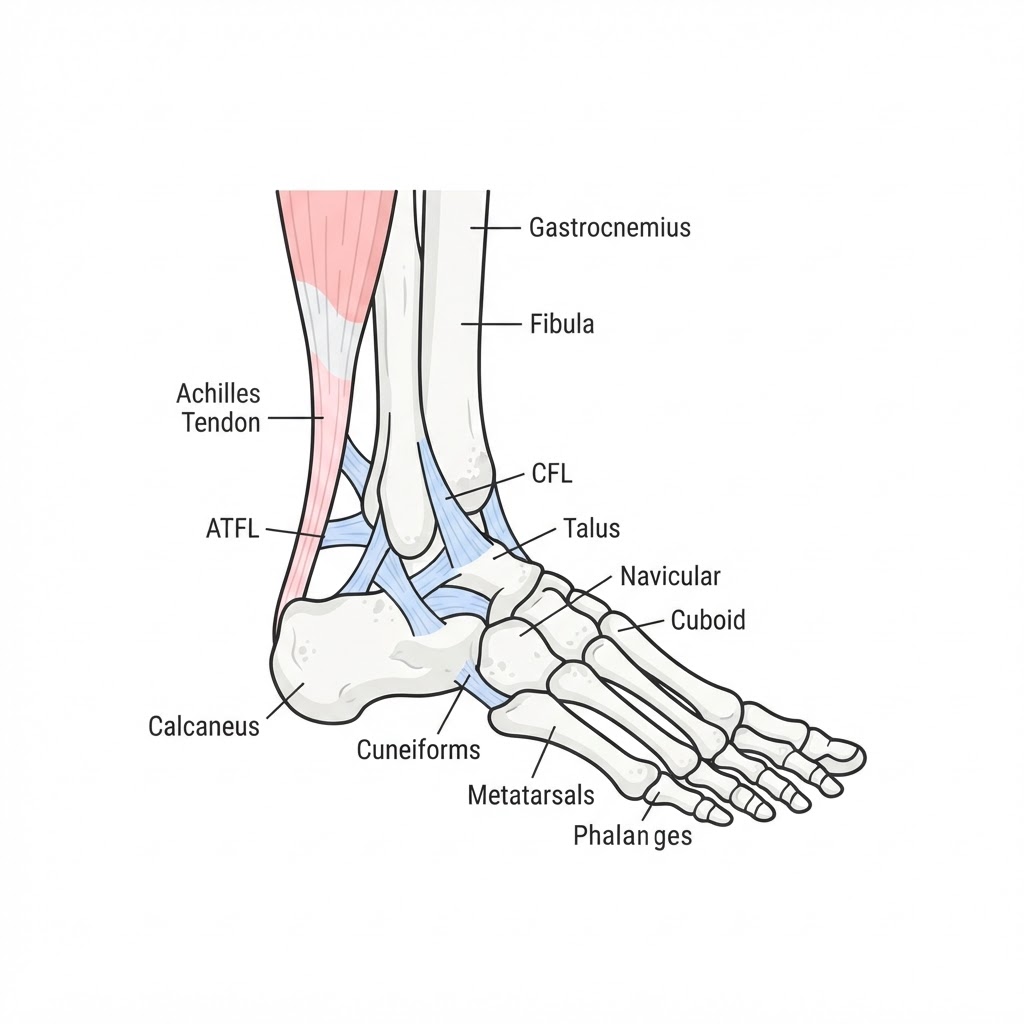
/ˈæŋkl/The joint connecting the foot to the leg, or the narrow part of the leg just above this joint.
Tiếng Việt
mắt cá chân
ĂNG-khồ
Nhấn mạnh vào âm 'ĂNG', âm 'khồ' phát âm nhẹ và nhanh ở cuối.
Khớp nối bàn chân với cẳng chân, hoặc phần hẹp của chân ngay phía trên khớp này.
Meanings
3 meanings
1The joint connecting the foot to the leg; the narrow part of the leg just above the ankle joint.noungeneral
Khớp nối bàn chân với cẳng chân; phần hẹp của chân ngay phía trên khớp mắt cá.
“She slipped on the ice and twisted her ankle.”
“Cô ấy bị trượt chân trên băng và bị trẹo mắt cá chân.”
- I had a broken ankle and couldn't walk for weeks.
- She has long legs and slender ankles.
- He was wearing boots that covered his ankles.
- The footballer went down clutching his ankle.
Người Việt thường nhầm lẫn giữa 'ankle' (mắt cá chân) và 'heel' (gót chân). Hãy nhớ 'ankle' là phần khớp lồi ra ở hai bên.
2To walk (slang); to leave or depart.verbslang
Đi bộ (từ lóng); rời đi hoặc khởi hành.
“We decided to ankle over to the party instead of driving.”
“Chúng tôi quyết định đi bộ đến bữa tiệc thay vì lái xe.”
- He ankled out of the room without saying goodbye.
Đây là cách dùng rất hiếm gặp và mang tính lóng cổ điển, học viên không nên sử dụng trong văn viết trang trọng.
3To cyclically angle the foot at the ankle while pedaling a bicycle to maximize efficiency.verbtechnical
Kỹ thuật gập duỗi cổ chân liên tục khi đạp xe để tối ưu hóa lực đạp.
“Professional cyclists ankle to maintain smooth power delivery.”
“Các tay đua xe đạp chuyên nghiệp sử dụng kỹ thuật 'ankling' để duy trì lực đạp đều đặn.”
- Learning to ankle correctly can improve your climbing speed.
Trong giới đua xe đạp tại Việt Nam, thuật ngữ này thường được gọi là kỹ thuật 'móc cổ chân' hoặc 'xoay cổ chân'.
Word bank
Grammar & forms
Grammar
- countable
- intransitive
Inflections
- plural
- ankles
- third_person_singular
- ankles
- past_simple
- ankled
- present_participle
- ankling
Word family
- ankletnoun
Usage patterns
- twist/sprain/break your ankle
- injure your ankle
Avoid mistakes
Common mistakes
I hurt in my ankle.
I hurt my ankle.
You hurt a body part directly; you do not hurt 'in' it.
She twisted the ankle.
She twisted her ankle.
In English, we typically use possessive pronouns (my, your, her, his) with body parts when describing injuries, rather than 'the'.
My uncle hurts.
My ankle hurts.
Confusion between 'uncle' (relative) and 'ankle' (body part) due to similar pronunciation.
He broke his foot ankle.
He broke his ankle.
Redundant usage; 'ankle' already implies the specific joint, no need to add 'foot'.
I have pain on my ankle.
I have pain in my ankle.
We usually use 'in' for internal pain within a joint.
Don't confuse with
- uncle
the brother of your father or mother
“My uncle lives in London.”
Pronunciation difference: Ankle is /ˈæŋkl/ (starts with 'a' sound like 'cat'), Uncle is /ˈʌŋkl/ (starts with 'u' sound like 'up').
Academic collocations
Words that pair with "ankle" in formal and academic writing
- verb
- fracturesprainrotate
- adjective
- lateralmedialunstable
- noun
- jointinjuryligament
- preposition
- atabove
In context
Real-world examples
- daily life
I sprained my ankle while playing football yesterday.
Tôi bị bong gân mắt cá chân khi chơi đá bóng ngày hôm qua.
Bóng đá là môn thể thao phổ biến nhất tại Việt Nam và chấn thương mắt cá chân rất thường gặp.
- academic
The doctor recommended an X-ray to see if the ankle bone was fractured.
Bác sĩ đề nghị chụp X-quang để xem xương mắt cá chân có bị rạn hay không.
Việc sử dụng thuật ngữ y khoa cơ bản là cần thiết khi đi khám tại các bệnh viện quốc tế.
- business
She bought a pair of stylish ankle boots for the winter.
Cô ấy đã mua một đôi bốt cổ thấp sành điệu cho mùa đông.
Ankle boots (bốt cổ ngắn/bốt tới mắt cá) là thuật ngữ thời trang phổ biến với giới trẻ Việt Nam.
Notes for Vietnamese speakers
- Ở Việt Nam, người dân thường sử dụng các loại dầu nóng hoặc cao dán khi bị đau mắt cá chân trước khi đi khám bác sĩ.
- Từ 'mắt cá chân' trong tiếng Việt xuất phát từ hình dáng của khớp xương này trông giống như con mắt của con cá.
Etymology
From Middle English ancle, from Old English ancleow. Cognate with German Enkel, Dutch enkel, and Sanskrit aṅga ('limb'). The root meaning implies 'bending' or 'angle'.
Exam levels
IELTS
4.0
CEFR
A2
TOEIC
255-400
More in Vietnamese
- TFlat Dictionary (Soha)
Cung cấp các nghĩa chuyên ngành và ví dụ minh họa chi tiết.
- Cambridge English–Vietnamese Dictionary
Nghĩa tiếng Việt kèm ví dụ từ Cambridge Dictionary.
- VDict (Anh–Việt)
Từ điển Anh–Việt với ví dụ song ngữ.