apostrophe
/əˈpɑːstrəfi/A punctuation mark (') used to show omission or possession, or a rhetorical device addressing an absent person or thing.
Tiếng Việt
dấu phẩy trên
ơ-PÓT-s-trơ-phì
Nhấn mạnh âm tiết thứ hai 'PÓT', âm 's' phát âm nhẹ, các âm còn lại đọc lướt.
Dấu câu (') dùng để chỉ sự tỉnh lược hoặc sở hữu, hoặc một biện pháp tu từ gọi tên một người hoặc vật vắng mặt (phép hô ngữ).
Meanings
4 meanings
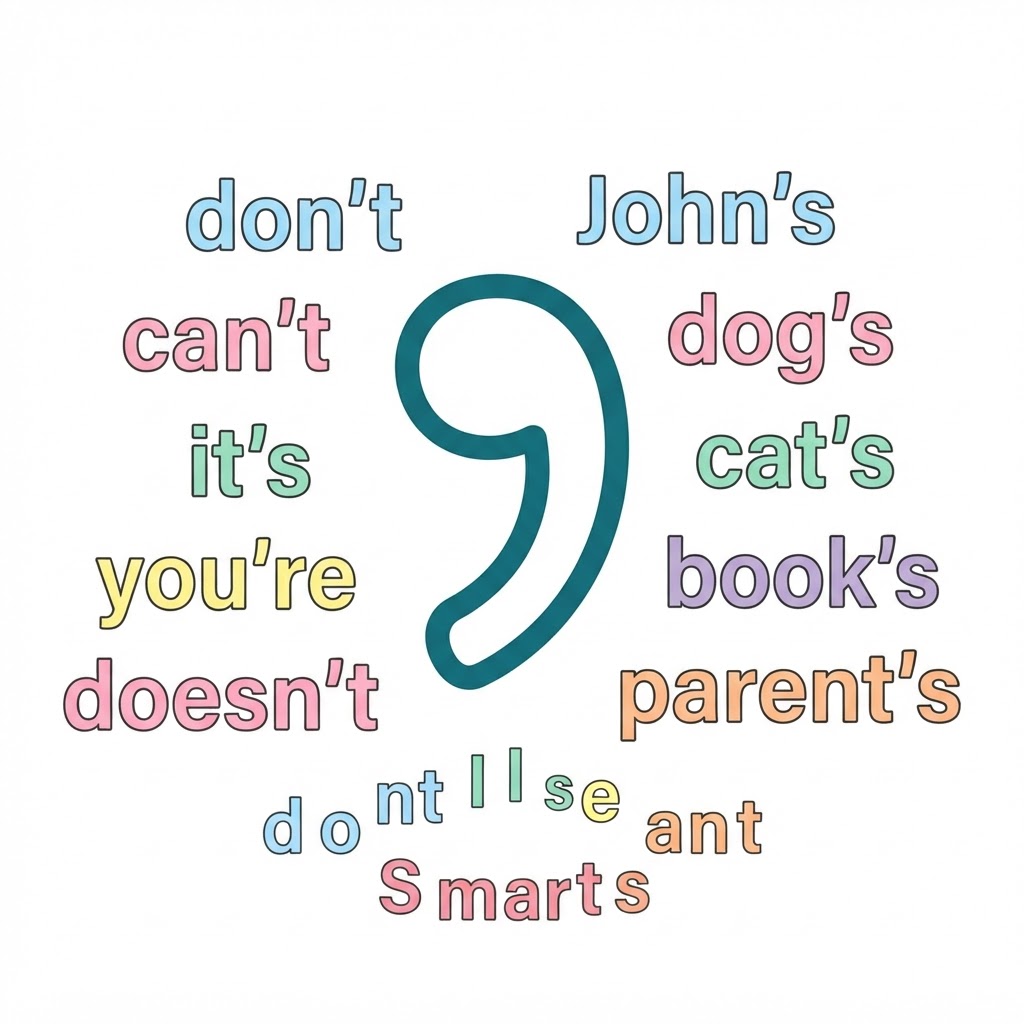
1The mark (’) used to show that one or more letters or numbers have been left out, as in she’s for she is and ’63 for 1963.general
Dấu (') được sử dụng để chỉ ra rằng một hoặc nhiều chữ cái hoặc chữ số đã bị lược bỏ, ví dụ như she’s thay cho she is và ’63 thay cho 1963.
“In the word "can't", the apostrophe shows that the letters "n" and "o" have been left out.”
“Trong từ "can't", dấu phẩy trên cho thấy các chữ cái "n" và "o" đã bị lược bỏ.”
- Make sure you put the apostrophe in the right place.
- Contractions like "she's" and "don't" always use an apostrophe.
Người học tiếng Việt cần chú ý không bỏ sót dấu này trong các từ viết tắt (contractions) như don't, can't, I'm vì tiếng Việt không có quy tắc viết tắt tương tự.
2The mark (’) used before or after the letter 's' to show that something belongs to somebody or something, as in Sam’s watch and the horses’ tails.general
Dấu (') được sử dụng trước hoặc sau chữ 's' để chỉ ra rằng một vật thuộc về một người hoặc một vật nào đó, ví dụ như Sam’s watch (đồng hồ của Sam) và the horses’ tails (đuôi của những con ngựa).
“You need an apostrophe in "Sam's watch" to show possession.”
“Bạn cần một dấu phẩy trên trong "Sam's watch" để thể hiện sự sở hữu.”
- The apostrophe goes after the 's' in plural nouns like "the horses' tails".
- It is a common mistake to forget the possessive apostrophe.
Sở hữu cách trong tiếng Anh khác với tiếng Việt (dùng từ 'của'). Hãy nhớ quy tắc: danh từ số ít dùng 's, danh từ số nhiều kết thúc bằng s thì chỉ cần thêm dấu phẩy trên (s').
3The mark (’) used before the letter 's' to show the plural of a letter or number.general
Dấu (') được sử dụng trước chữ 's' để chỉ số nhiều của một chữ cái hoặc chữ số.
“How many 3's are there in 9?”
“Có bao nhiêu chữ số 3 trong số 9?”
- There are two m's in the word 'comma'.
Cách dùng này ngày nay ít phổ biến hơn đối với các con số (ví dụ: 1990s thường không có dấu phẩy trên), nhưng vẫn được dùng cho chữ cái để tránh nhầm lẫn (ví dụ: dot your i's).
4A rhetorical device in which a speaker or writer directly addresses an absent person, an abstract idea, or an inanimate object.literary
Một biện pháp tu từ trong đó người nói hoặc người viết trực tiếp gọi tên hoặc trò chuyện với một người vắng mặt, một ý niệm trừu tượng hoặc một vật vô tri vô giác (phép hô ngữ).
“In his poem, he uses apostrophe to speak directly to the wind.”
“Trong bài thơ của mình, ông ấy sử dụng phép hô ngữ để nói chuyện trực tiếp với cơn gió.”
- Shakespeare frequently used apostrophe in his plays, such as when Juliet addresses the night.
- An example of apostrophe is the famous line 'O Death, where is thy sting?'
Trong ngữ cảnh văn học, 'apostrophe' không phải là dấu câu mà là 'phép hô ngữ', tương đương với các thán từ gọi đáp trong thơ ca Việt Nam (ví dụ: 'Hỡi ơi...').
Word bank
Near synonyms
Common phrases
- use an apostrophe
- put an apostrophe
- misplaced apostrophe
- missing apostrophe
- possessive apostrophe
Grammar & forms
Avoid mistakes
Common mistakes
The dog wagged it's tail.
The dog wagged its tail.
'Its' without an apostrophe is the possessive form. 'It's' with an apostrophe means 'it is' or 'it has'.
I bought some apple's.
I bought some apples.
Do not use an apostrophe to make regular nouns plural (often called the 'greengrocer's apostrophe').
The book is her's.
The book is hers.
Possessive pronouns (hers, yours, ours, theirs) do not take an apostrophe.
He is from the 1990's.
He is from the 1990s.
In modern style guides, decades do not usually take an apostrophe to form the plural.
The boys hat was blue.
The boy's hat was blue.
An apostrophe is needed to show possession (the hat belonging to the boy).
Don't confuse with
- comma
a punctuation mark (,) indicating a pause between parts of a sentence
“Use a comma to separate items in a list.”
An apostrophe is placed at the top of the line ('), while a comma is placed at the bottom (,).
- quotation mark
punctuation marks used in pairs to mark a quotation or speech
“She said, "Hello!"”
Quotation marks are often double (") and used for speech, while an apostrophe is single (') and used for possession or omission.
Academic collocations
Words that pair with "apostrophe" in formal and academic writing
- verb
- useinsertomitplace
- adjective
- misplacedmissingpossessiveomitted
- noun
- useplacementerrormark
- preposition
- inbeforeafter
In context
Real-world examples
- academic
Make sure you put the apostrophe in the right place when writing 'don't'.
Hãy đảm bảo bạn đặt dấu phẩy trên đúng chỗ khi viết 'don't'.
Học sinh Việt Nam thường quên hoặc đặt sai vị trí dấu phẩy trên khi học viết tiếng Anh do tiếng Việt không có dấu câu này.
- daily life
The sign outside the shop had a misplaced apostrophe, reading 'Apple's for sale'.
Biển hiệu bên ngoài cửa hàng có một dấu phẩy trên bị đặt sai vị trí, ghi là 'Apple's for sale'.
Lỗi 'greengrocer's apostrophe' (dùng sai dấu phẩy trên cho danh từ số nhiều) rất phổ biến ngay cả với người bản xứ, là bài học quan trọng để bạn tránh mắc phải.
- business
In our company's style guide, we strictly follow the rules for possessive apostrophes.
Trong cẩm nang văn phong của công ty chúng tôi, chúng tôi tuân thủ nghiêm ngặt các quy tắc về dấu phẩy trên chỉ sự sở hữu.
Trong môi trường làm việc quốc tế tại Việt Nam, việc sử dụng đúng dấu câu thể hiện sự chuyên nghiệp và cẩn thận trong giao tiếp email và văn bản.
- literary
The poet used apostrophe to address the ocean directly.
Nhà thơ đã sử dụng phép hô ngữ để trực tiếp trò chuyện với đại dương.
Phép tu từ 'hô ngữ' (apostrophe) trong văn học Anh có nét tương đồng với phép nhân hóa và gọi đáp trong văn học Việt Nam (ví dụ: 'Hỡi sông Hồng...').
Notes for Vietnamese speakers
- Trong tiếng Việt không có dấu phẩy trên (') để chỉ sự sở hữu hay viết tắt như tiếng Anh, do đó bạn thường hay quên sử dụng dấu này khi mới bắt đầu học.
- Lỗi sai phổ biến của người Việt khi học tiếng Anh là nhầm lẫn giữa 'its' (của nó) và 'it's' (nó là), hoặc thêm dấu phẩy trên vào danh từ số nhiều (ví dụ: viết 'cat's' thay vì 'cats').
- Trong văn học, 'apostrophe' không chỉ là dấu câu mà còn là một biện pháp tu từ (phép hô ngữ), tương tự như cách các nhà thơ Việt Nam hay gọi đáp các sự vật vô tri vô giác.
Etymology
From late 16th century: via late Latin from Greek apostrophos 'accent of elision', from apostrephein 'turn away', from apo- 'from' + strephein 'to turn'. The rhetorical sense comes from the same Greek root, referring to a speaker 'turning away' from the audience to address a specific person or thing.
Exam levels
IELTS
6.0
CEFR
B1
TOEIC
505-600
More in Vietnamese
- Cambridge English–Vietnamese Dictionary
Nghĩa tiếng Việt kèm ví dụ từ Cambridge Dictionary.
- VDict (Anh–Việt)
Từ điển Anh–Việt với ví dụ song ngữ.